

Gas vs Electric vs Steam Commercial Dryer: Which Is Cheaper in India?
Choosing the right commercial tumble dryer is not just about machine capacity or purchase price. For laundry businesses in India, daily running costs can significantly affect profitability, especially when machines operate for several hours.
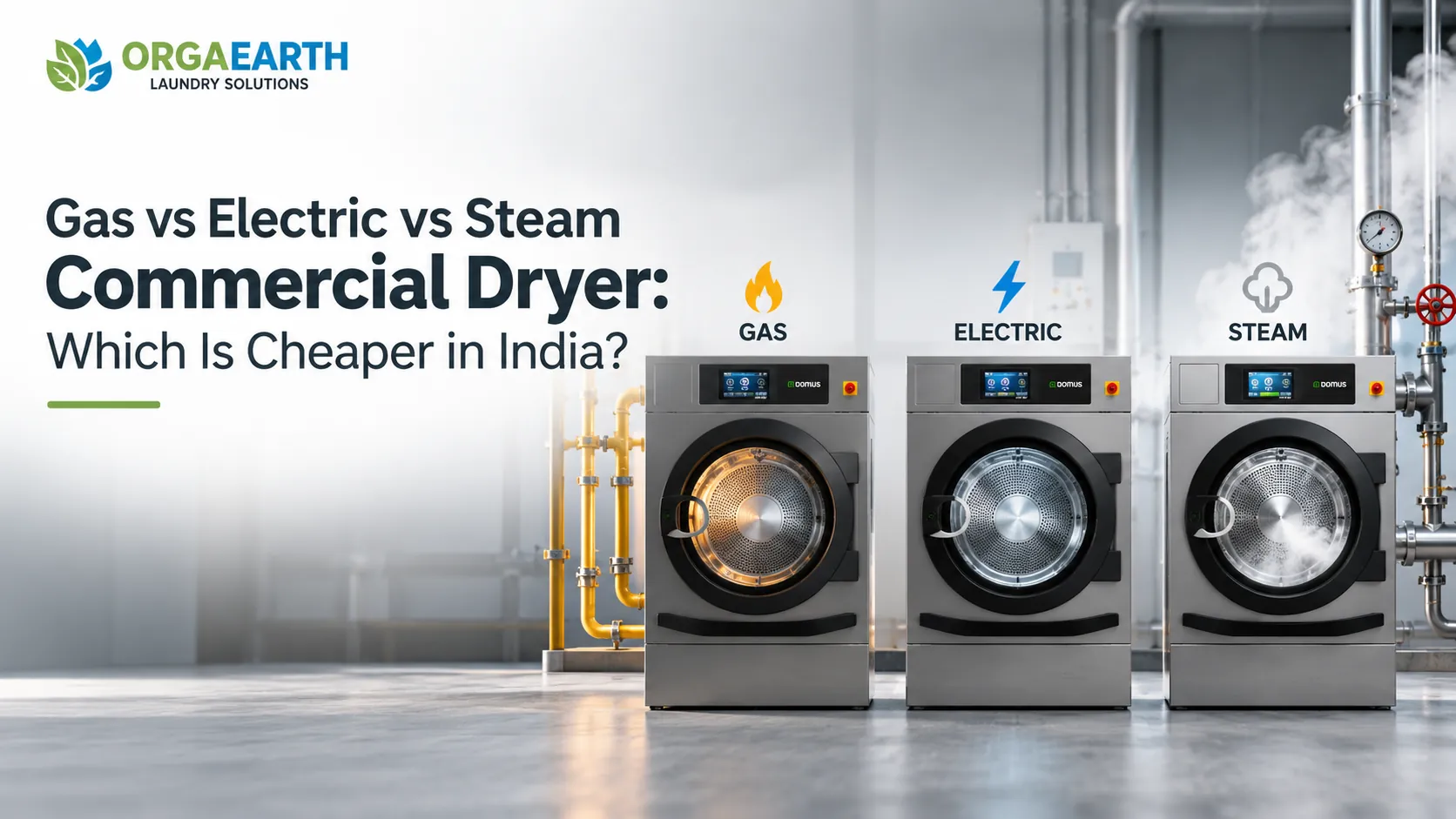
Electric, gas, and steam-heated dryers all perform the same basic function, but their energy requirements, installation costs, and operating expenses differ. A dryer that is economical for a small laundromat may not be the most practical choice for a hotel, hospital, or industrial laundry plant.
So, which is cheaper to operate in India: a gas, electric, or steam commercial dryer?
The answer depends on local energy prices, daily laundry volume, available infrastructure, and machine efficiency. Understanding these differences can help businesses make better equipment decisions and control long-term expenses.
What Is a Commercial Tumble Dryer and How Does It Work?
A commercial tumble dryer removes moisture from washed textiles by circulating heated air through a rotating drum. These machines are designed for regular business use, handling items such as towels, bedsheets, uniforms, and garments.
Unlike domestic dryers, commercial machines are built to handle larger laundry volumes and demanding operating schedules.
The heating system is one of the most important considerations when choosing a dryer. It determines how heat is generated and influences utility consumption, installation requirements, and operating expenses.
Three commonly used heating options are:
- Electric: Uses electrical heating elements to generate heat.
- Gas: Uses LPG or natural gas to heat the drying air.
- Steam: Uses steam supplied by a boiler or central steam system to heat air through a heat exchanger.
Each option has advantages depending on the laundry’s operational requirements.
Gas vs Electric vs Steam Commercial Dryer: Key Differences
Before comparing costs, it is important to understand how these heating systems differ.
Factor | Electric Dryer | Gas Dryer | Steam Dryer |
Heating source | Electricity | LPG or natural gas | Boiler-generated steam |
Installation | Electrical supply and ventilation | Gas supply, safety systems and ventilation | Steam connections and supporting infrastructure |
Initial setup | Relatively straightforward where adequate power is available | Requires gas infrastructure | Can be costly without an existing boiler |
Running cost | Depends on electricity tariff | Depends on gas price and consumption | Depends on steam-generation cost |
Maintenance | Electrical and mechanical components | Burner, gas system and mechanical components | Steam system, valves and mechanical components |
Suitable applications | Small and medium commercial laundries | Laundries with suitable gas availability | Facilities with established steam systems |
No single heating system is automatically the most economical. Actual savings depend on energy consumption, utility prices, and how efficiently the equipment is operated.
Electric Tumble Dryer Running Cost in India
An electric tumble dryer generates heat through electrical heating elements. It is often a practical option for businesses without gas connections or steam infrastructure.
However, electricity consumption can become a major operating expense when dryers run throughout the day.
How to Calculate Electric Dryer Running Cost
A simple calculation is:
Electricity cost per load = Energy consumed (kWh) × Electricity tariff (₹/kWh)
For example, assume a dryer consumes 9 kWh during one drying cycle and the electricity tariff is ₹9 per unit.
Estimated cost:
9 × ₹9 = ₹81 per load
If the business processes 10 loads daily for 26 days:
₹81 × 10 × 26 = ₹21,060 per month
This is an illustrative calculation, not a standard consumption figure for every machine. Actual usage depends on heating power, cycle duration, load moisture, and operating conditions. Fixed electricity charges and demand-related costs may also apply.
Electric dryers are worth considering when reliable electrical infrastructure is available and installing a separate fuel system would be impractical.
Gas Tumble Dryer Running Cost in India
A gas tumble dryer uses LPG or piped natural gas to generate drying heat. Gas-heated machines are commonly considered by businesses looking for an alternative to electric heating.
Their operating cost depends on fuel consumption, local gas prices, burner efficiency, and drying time.
How to Calculate Gas Dryer Running Cost
For an LPG-powered machine:
Gas cost per load = LPG consumed (kg) × LPG price per kg
Suppose a dryer uses 0.7 kg of LPG during a cycle, with an assumed fuel cost of ₹95 per kg.
Estimated cost:
0.7 × ₹95 = ₹66.50 per load
For 10 loads daily over 26 operating days:
₹66.50 × 10 × 26 = ₹17,290 per month
This calculation excludes electricity used by the drum motor, fans, and controls, as well as any fixed gas infrastructure costs.
If natural gas is used instead, the calculation should follow the supplier’s billing unit and tariff.
Gas heating may offer lower running expenses where fuel is competitively priced. However, businesses must also consider connection charges, appropriate ventilation, and regular burner maintenance.
Steam Tumble Dryer Running Cost in India
A steam tumble dryer uses steam from an external boiler to heat the drying air through a heat exchanger.
Steam heating can be particularly relevant to hotels, hospitals, and industrial laundry facilities that already operate boilers for washing, finishing, or other processes.
Unlike electric and gas dryers, steam-heated models depend on a separate steam-generation system.
How to Calculate Steam Dryer Running Cost
A practical estimate is:
Steam cost per load = Steam consumed (kg) × Effective steam cost per kg
For example, suppose a dryer consumes 14 kg of steam per cycle and the effective steam-generation cost is ₹4 per kg.
Estimated cost:
14 × ₹4 = ₹56 per load
For 10 daily loads over 26 days:
₹56 × 10 × 26 = ₹14,560 per month
These figures are hypothetical. The effective steam cost must account for boiler fuel, efficiency, water treatment, and relevant operating expenses. The dryer also consumes electricity for mechanical operation.
Steam heating may be economical when an efficient boiler is already available. Installing a new boiler solely for a small drying operation may change the financial calculation considerably.
Gas vs Electric vs Steam Commercial Dryer: Cost Comparison
To understand the possible difference in operating expenses, consider the following illustrative scenarios.
Cost factor | Electric | LPG Gas | Steam |
Assumed energy use per load | 9 kWh | 0.7 kg LPG | 14 kg steam |
Assumed unit rate | ₹9/kWh | ₹95/kg | ₹4/kg |
Heating cost per load | ₹81 | ₹66.50 | ₹56 |
Heating cost for 260 loads | ₹21,060 | ₹17,290 | ₹14,560 |
Important: These are calculation examples, not verified measurements from equivalent dryer models. They exclude certain auxiliary energy and fixed costs. The three scenarios should not be treated as a direct performance test or proof that steam is always cheapest.
For a reliable comparison, request model-specific consumption data, use the same laundry load and target dryness, and apply the actual utility rates at your facility.
What Factors Affect Commercial Tumble Dryer Operating Costs?
The heating system is only one part of total operating expenditure. Several practical factors can influence energy consumption.
1. Laundry Load and Capacity
Operating a dryer with unsuitable load sizes can reduce efficiency. Businesses should match equipment capacity to their regular workload rather than selecting a larger machine without evaluating actual demand.
2. Moisture Remaining After Washing
Clothes with high residual moisture require more drying energy. An efficient commercial washer extractor can remove more water during extraction, helping reduce the work required from the dryer.
3. Drying Time and Temperature
Excessive drying time increases energy consumption and may affect fabric quality. Suitable drying programs and moisture-control features can help avoid unnecessary heating.
4. Airflow and Maintenance
Blocked lint filters, restricted exhaust ducts, and poorly maintained components can increase drying time. Regular cleaning and servicing are important for maintaining consistent machine performance.
5. Local Energy Tariffs
Commercial electricity rates, LPG prices, natural gas availability, and boiler fuel costs vary across India. The most economical heating option in one location may not be the cheapest elsewhere.
Which Commercial Tumble Dryer Is Best for Your Laundry Business?
Different laundry facilities have different operating requirements.
Small laundromats and dry-cleaning stores
Electric dryers may be convenient when suitable electrical capacity is available and daily laundry volume is manageable. Gas heating is also worth evaluating where fuel infrastructure is practical.
Hotels and resorts
Hotels frequently process towels, bedsheets, and uniforms. Depending on daily volume and existing utilities, gas or steam heating may be suitable for continuous laundry operations.
Hospitals and healthcare facilities
Facilities with centralized steam systems can evaluate steam-heated dryers alongside existing boiler capacity and laundry demand.
Industrial laundry plants
High-volume operators should compare energy cost per kilogram, machine productivity, fuel availability, and infrastructure expenses before selecting a heating system.
Businesses planning new equipment purchases can also review this industrial tumble dryer buying guide for additional selection considerations.
How to Choose an Energy-Efficient Commercial Tumble Dryer
Before investing in a dryer, consider these essential questions:
- What quantity of laundry needs drying every day?
- Which energy sources are available at the facility?
- What is the expected energy cost per kilogram of dried laundry?
- Does the building have the necessary electrical, gas, or steam infrastructure?
- What are the installation and maintenance requirements?
- Does the machine offer suitable drying programs or moisture-control features?
The lowest purchase price does not necessarily mean the lowest long-term cost.
Businesses should compare total ownership expenses, including equipment, installation, energy, maintenance, and expected operating hours.
How Orgaearth Can Help You Choose the Right Commercial Tumble Dryer
Selecting the right drying equipment requires more than comparing machine specifications.
At Orgaearth Laundry Solutions, we help businesses evaluate their laundry requirements and identify suitable commercial and industrial equipment.
Our range includes commercial and industrial tumble dryers with different capacities and heating configurations for laundromats, hotels, hospitals, and large laundry operations.
We can assist with:
- Dryer capacity and heating-system selection
- Equipment planning according to daily laundry volume
- Utility and installation considerations
- Commercial laundry equipment selection
- Installation and technical support
Whether you are establishing a new laundry or upgrading existing equipment, choosing the appropriate heating system can help you manage operating expenses more effectively.
Explore Orgaearth’s tumble dryer range or contact our team to discuss your equipment requirements: https://orgaearth.com/metform-form/new-form-1718879149/
Conclusion
So, which commercial dryer is cheaper to operate in India?
Electric dryers can be practical where installation simplicity and electrical availability are priorities. Gas dryers may provide an economical heating alternative where fuel prices are competitive. Steam dryers can be attractive for facilities that already have efficient boiler infrastructure.
However, the actual cost difference depends on machine efficiency, local tariffs, daily workload, and installation requirements.
Before purchasing, compare the commercial tumble dryer running cost, energy consumption, and total ownership expenses using your facility’s operating conditions.
The right choice is the dryer that meets your laundry’s capacity requirements while keeping long-term costs under control.
Contact Us
Orgaearth Laundry Solutions
Plot no. 774, Udyog Vihar, Phase 5, Gurugram, Haryana, India 122016
Email: marketing@orgaearth.com
Contact No.: +91 7042912777
Frequently Asked Questions
There is no universally cheapest option. Gas heating may cost less where fuel prices are competitive, while steam heating can be economical when an efficient boiler is already available. Electric dryer expenses depend largely on electricity tariffs and consumption.
Commercial dryer electricity consumption varies with machine capacity, heating power, fabric moisture, and drying duration. Multiply actual kWh consumed by the electricity tariff to estimate the cost per cycle.
A gas dryer can have lower heating costs in locations with affordable fuel. However, gas installation, auxiliary electricity, maintenance, and local tariffs must be included in the overall comparison.
There is no single reliable national average because dryer models, load sizes, utility tariffs, and operating conditions differ. Businesses should calculate cost per load using equipment consumption data and their actual energy rates.
Yes. Steam-heated dryers can be suitable for hotels and hospitals that already operate centralized steam systems. Boiler capacity, steam pressure, and overall steam-generation costs should be checked before installation.
Maintain clean lint filters and exhaust systems, avoid unnecessary over-drying, use appropriate load sizes, select suitable programs, and ensure adequate water extraction before drying.