

Front Load vs Top Load Washing Machine: Which Should You Buy for a Laundry Business?
This guide explains the key differences, running-cost factors and capacity considerations—and when a commercial washing machine may make more sense than either domestic option.
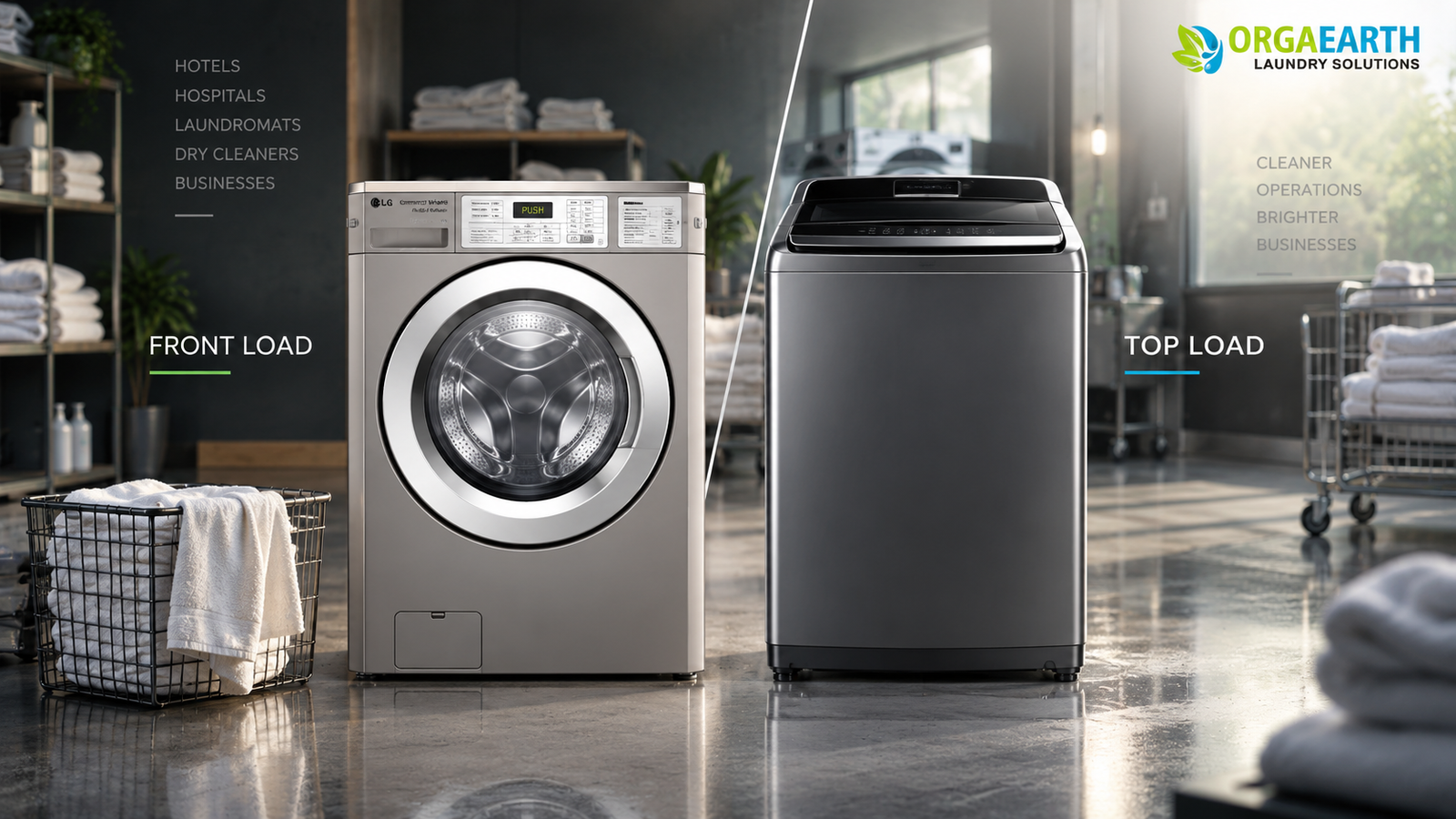
Choosing between a front-load vs top load washing machine is not only about where you put the clothes. The two designs differ in wash action, water use, loading method, space requirements and operating characteristics. For a laundry business, the decision becomes even more important because the machine may need to handle repeated loads and predictable turnaround every day.
What Is the Difference Between Front Load and Top Load Washing Machines?
The main difference between front load and top load washing machines is the drum orientation and loading position.
A front load washing machine has a door on the front and typically uses a horizontally mounted drum. Clothes move through the wash solution as the drum rotates.
A top load washing machine is loaded from above and typically uses a vertically positioned drum. The exact wash mechanism varies by machine design.
Here is a simple comparison:
Factor | Front Load | Top Load |
Loading | From the front | From the top |
Drum orientation | Horizontal | Vertical |
Water requirement | Generally lower | Can be higher depending on design |
Loading convenience | Requires front access | Easy access from above |
Space planning | Can allow stacking on compatible models | Requires clear space above |
Business suitability | Depends on model and workload | Depends on model and workload |
When comparing the front load and top load washing machine difference, do not judge only by convenience. Consider how frequently the machine will run, the type of textiles being processed and whether it is designed for the expected workload.
Front Load vs Top Load Washing Machine: Which Uses Less Water, Electricity and Costs Less to Run?
Front load machines generally use less water because their wash action does not require the drum to remain filled to the same extent as many traditional top load designs. However, actual washing machine water consumption varies by model, load, selected program and machine technology.
Electricity is more complicated.
A front load machine should not automatically be considered cheaper to operate simply because it uses less water. Actual electricity consumption can be affected by:
- Cycle duration
- Water heating
- Load size
- Spin speed
- Selected wash program
- Machine efficiency
- Number of cycles per day
This becomes especially important for a laundry business because a small difference per cycle can become more significant across repeated daily operation.
Maintenance should also be considered when comparing front load vs top load maintenance cost. Purchase price alone does not represent the complete cost of owning a machine.
A more useful business calculation is:
Operating Cost Per Load = Water + Electricity + Chemicals + Relevant Operating Costs
You can go one step further:
Washing Cost Per KG = Total Relevant Washing Cost ÷ Total KG Processed
For example, if the relevant washing costs for a period are ₹12,000 and the machine processes 2,000 KG:
₹12,000 ÷ 2,000 KG = ₹6 per KG
This is only an illustrative calculation, not an industry benchmark. Your actual cost will depend on the machine, utilities, wash process, textiles and operating conditions.
Which Is Better for Frequent Daily Use: Front Load or Top Load Washing Machine?
For occasional household use, convenience, price and features may drive the purchase decision. Frequent business use requires a different approach.
Instead of asking only “front load vs top load washing machine—which is better?”, ask:
How many kilograms must this machine reliably process during my operating day?
For repeated washing, evaluate:
- Practical load capacity
- Number of expected loads per day
- Cycle duration
- Extraction performance
- Water and electricity requirements
- Textile and soil mix
- Operating hours
- Required turnaround
- Manufacturer-specified duty and application
Cleaning performance also should not be reduced to the loading direction alone. Wash quality is influenced by machine design, wash program, detergent selection, temperature where applicable, soil level and correct loading.
The same applies to capacity.
A machine carrying a particular KG rating does not necessarily mean that every textile category should be loaded to that figure in every program. Practical loads depend on the textiles and process being used.
This distinction becomes increasingly important as washing frequency increases.
A machine that works well for a few household loads does not automatically become the right washing machine for commercial use simply by running it more often.
Which Is Better for a Laundry Business: Front Load or Top Load Washing Machine?
For a laundry business, neither front load nor top load should automatically be declared the better choice without understanding the operation.
Start with your expected laundry volume.
Use:
Required Loads Per Day = Expected Daily Laundry KG ÷ Practical Average Load
Suppose a startup expects to process 120 KG per day and its practical average load is 12 KG:
120 KG ÷ 12 KG = 10 loads per day
This is an illustrative planning example rather than a capacity recommendation.
Now ask whether the machine under consideration is designed to complete those loads within the available operating hours while supporting the required turnaround.
Your decision process should therefore look like:
Daily Laundry KG → Textile Mix → Practical Load → Loads Per Day → Operating Hours → Required Machine Capacity
For example, a laundromat, dry cleaner adding laundry services, hostel laundry or small B2B operation may have very different requirements despite processing a similar total number of kilograms.
This is why washing machine capacity for a laundry business should be calculated from actual operations rather than choosing a machine based only on price or advertised capacity.
You should also consider what happens after washing.
If washing capacity increases but drying or finishing cannot keep up, the additional washer capacity may simply move the bottleneck to the next stage.
When Should a Laundry Business Choose a Commercial Washing Machine Instead?
This is where the front load vs top load comparison needs to move beyond household buying advice.
If you are starting a business, the more important question may eventually become:
Do I need a domestic washing machine at all, or should I evaluate a commercial washing machine?
A purpose-built commercial washing machine should be considered when the expected workload, operating frequency, and business dependence on the equipment require capabilities suited to commercial operation.
Evaluate a commercial option when factors such as these become important:
- Multiple repeated loads during operating hours
- Higher daily laundry volume
- Consistent turnaround requirements
- Business revenue dependent on machine availability
- Need for appropriate commercial programs and controls
- Higher processing-capacity requirements
- Integration with commercial drying and finishing equipment
- Long-term expansion plans
A commercial front load washing machine, for example, should be evaluated using its actual manufacturer specifications, rated application, extraction capability, available programs, utilities and installation requirements—not simply because it loads from the front.
Similarly, moving to an industrial washing machine should be based on the scale and requirements of the operation rather than assuming bigger equipment is automatically better.
Before buying, calculate:
Expected Volume → Required Loads → Operating Hours → Washing Capacity → Drying Capacity → Utilities → Space → Investment
That provides a much stronger basis for equipment selection than comparing only front load vs top load features.
How Orgaearth Can Help
Choosing a washing machine for a business requires more than comparing features on a specification sheet.
Orgaearth helps commercial laundry businesses evaluate equipment according to expected daily volume, practical load requirements, available space, utilities, workflow and future processing requirements.
Whether you are planning a new laundry setup, expanding an existing operation or evaluating commercial laundry equipment, the objective is to choose capacity that supports the actual business rather than investing in equipment that is either insufficient or unnecessarily oversized.
Conclusion
The front load vs top load washing machine decision should go beyond price and loading convenience, especially when the machine is being purchased for a business. Compare water and power requirements, practical capacity, workload, operating cost and daily processing needs—and if your laundry depends on repeated cycles and consistent output, evaluate whether a purpose-built commercial machine is the more appropriate investment.
Contact Us
Orgaearth Laundry Solutions
Plot no. 774, Udyog Vihar, Phase 5, Gurugram, Haryana, India 122016
Email: marketing@orgaearth.com
Contact No.: +91 7042912777
Frequently Asked Questions
It depends on the application. Front load machines generally offer lower water consumption, while top load machines provide convenient loading from above. Compare individual models based on capacity, wash performance, utilities, operating cost and expected usage.
The most obvious difference is loading position and drum orientation. Front load machines typically use a horizontal drum, while top load machines are loaded from above and generally use a vertical drum design.
Front load washing machines generally use less water than many traditional top load designs. Actual consumption should still be checked using the specifications of the models being compared.
It can be suitable depending on the machine and workload. For repeated business use, evaluate whether the specific model is designed for the required daily volume, number of cycles and operating conditions rather than selecting it solely because it is front loading.
There is no single capacity suitable for every laundry. Calculate expected daily KG, textile mix, practical load size, number of loads, operating hours and turnaround requirements before choosing capacity.
Consider a commercial washing machine when repeated daily usage, processing volume, turnaround requirements and dependence on equipment exceed what is appropriate for the domestic machines you are considering.