

Flatwork Ironer vs Steam Press: Which Is Better for Commercial Laundry?
Choosing between a flatwork ironer and a steam press depends on the textiles being processed, daily workload and finishing requirements. Both machines use heat to remove wrinkles, but their working methods and applications differ considerably.
For commercial laundry owners planning to purchase an industrial ironing machine, understanding these differences can help prevent unnecessary investment and improve daily operations.
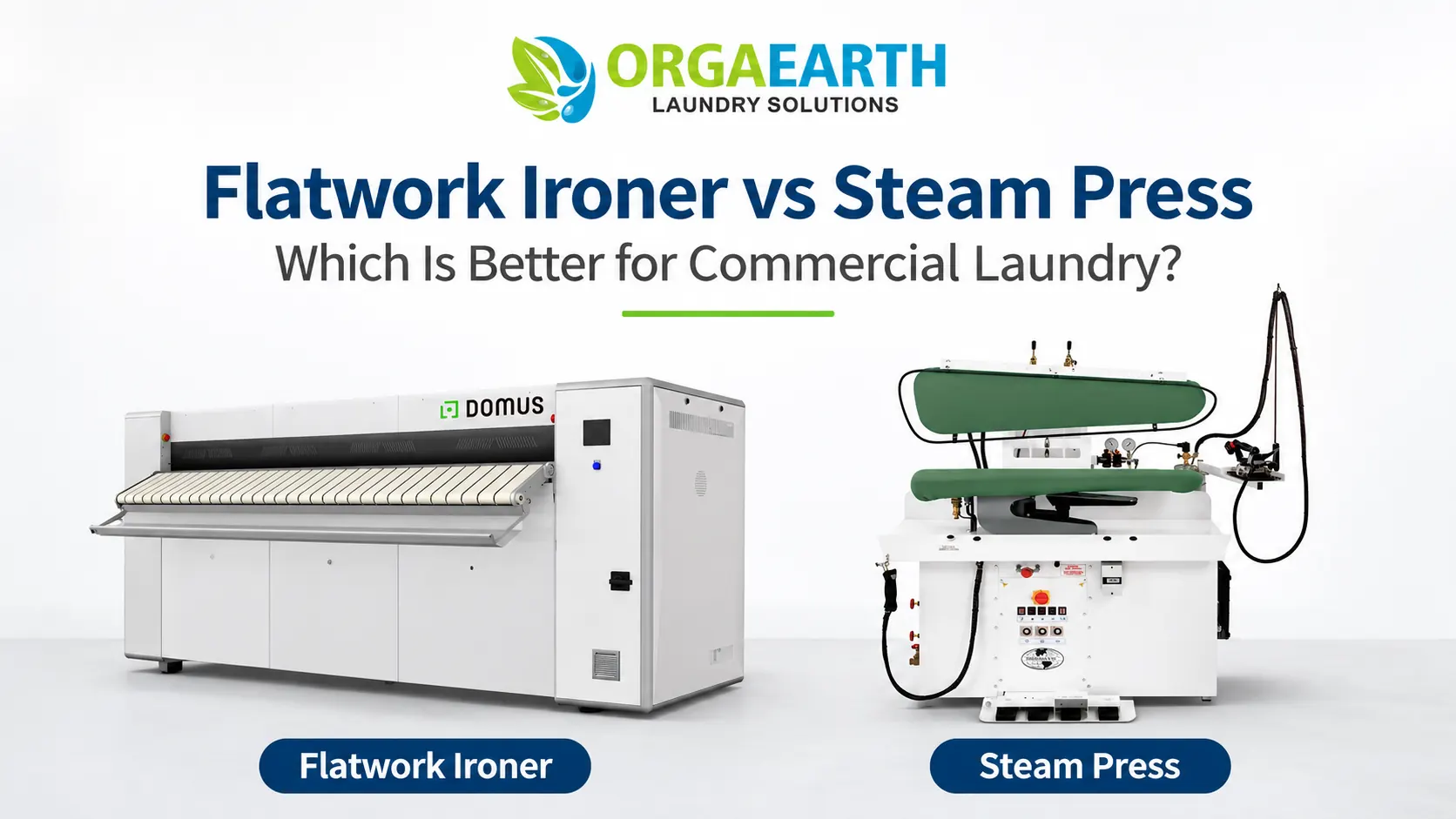
What Is a Flatwork Ironer in Commercial Laundry?
A flatwork ironer is a professional laundry machine designed to finish large, relatively flat textiles such as bedsheets, pillowcases, tablecloths and suitable duvet covers.
The machine uses heated rollers or ironing surfaces to remove wrinkles as linen passes through the equipment.
Unlike manual pressing, suitable flat linen can be fed continuously, making the equipment useful for businesses handling regular linen volumes.
Some models can process appropriately extracted damp linen, while others require prior drying.
For hotels, hospitals and commercial linen processors, an industrial flatwork ironer can be considered when manual finishing becomes a production bottleneck.
What Is a Commercial Steam Press Machine and How Does It Work?
A commercial steam press machine is designed to finish garments through controlled heat, pressure and, where supported, steam and vacuum. Professional presses may use shaped pressing surfaces suited to particular garment sections.
They are commonly used for shirts, trousers, uniforms, jackets and other compatible clothing. Unlike a flatwork ironer, a garment press allows operators to position specific areas for finishing.
Some professional models use pneumatic or mechanical pressing systems, depending on their design. Orgaearth’s professional utility press equipment includes machinery intended for commercial garment-finishing applications.
Flatwork Ironer vs Steam Press: What Are the Key Differences?
The main distinction is the type of textile each machine is designed to handle.
Factor | Flatwork ironer | Steam press |
Primary application | Flat linen | Shaped garments |
Suitable items | Bedsheets, tablecloths, pillowcases | Shirts, trousers, uniforms |
Working method | Continuous roller-based finishing | Targeted pressing |
Productivity | Depends on linen dimensions and feed speed | Depends on garment type and operator |
Labour | Feeding, receiving and folding | Positioning and pressing |
Space | Roller and feeding clearance | Pressing station and operator access |
These machines are not direct replacements for one another.
A linen-focused laundry may benefit more from a flatwork ironer, while a garment-care business may require professional presses.
Which Industrial Ironing Machine Is Better for Bedsheets and Hotel Linen?
Large bedsheets can be difficult to finish consistently using conventional pressing stations, especially when the daily volume increases. A flatwork ironer allows suitable linen to pass through a heated finishing system. This makes it worth evaluating for hotels, commercial laundries and institutional facilities handling substantial quantities of flat textiles. However, roller width must match the linen dimensions and approved feeding arrangement.
For example, Orgaearth’s DOMUS Compact Flatwork Ironer S range includes different roller widths and heating configurations. The right model depends on bedsheet dimensions, incoming moisture and required hourly production.
Which Commercial Ironing Machine Is Better for Shirts, Trousers and Uniforms?
Shirts and trousers have collars, cuffs, seams and shaped sections that require different finishing techniques. A commercial steam press can provide controlled pressing for compatible garments.
Professional ironing tables and specialised presses may also be required for particular garment categories. For laundromats, dry cleaners and uniform-processing businesses, flexibility across different clothing types is often more important than continuous flat-linen output.
Before purchasing, evaluate which garments make up the majority of customer orders. One pressing machine may not be suitable for every garment construction or fabric.
Flatwork Ironer vs Steam Press: Which Offers Higher Productivity?
Productivity cannot be compared using machine speed alone. A flatwork ironer may process suitable linen continuously, whereas garment pressing involves positioning and finishing individual items.
Consider a hotel laundry finishing 200 bedsheets daily.
If five working hours are available, the equipment must support an average output of:
200 ÷ 5 = 40 bedsheets per hour
This is a required production rate, not a guaranteed machine output. Actual flatwork ironer productivity depends on roller width, speed, incoming moisture, linen size and operator arrangements. For garment presses, productivity depends on clothing complexity and finishing requirements.
Which Commercial Ironing Machine Has Lower Operating Costs?
Purchase price is only one part of the comparison. Operating expenses may include labour, electricity, steam, maintenance and equipment ownership costs.
A flatwork ironer may be economical for regular flat-linen volumes, but unsuitable for finishing shaped garments. Similarly, using a steam press for large quantities of bedsheets may require additional handling.
A practical calculation is:
Cost per finished item = Total finishing expenses ÷ Accepted finished items
Compare actual production records and equipment quotations rather than assuming mechanisation always reduces costs.
How Much Space and Installation Infrastructure Do Both Machines Require?
Before purchasing, check equipment dimensions, operator clearance and the available utilities. Flatwork ironers may need substantial space for linen feeding, collection and maintenance.
Steam presses require suitable working space, electrical connections and steam or vacuum services where applicable. Heating arrangements vary by machine.
The selected equipment may also have specific ventilation and floor requirements.
Review Orgaearth’s commercial laundry machine installation requirements before finalising your laundry layout.
When Should a Laundry Business Invest in an Industrial Flatwork Ironer?
An industrial flatwork ironer becomes worth considering when flat-linen finishing regularly consumes substantial labour time or delays customer deliveries.
Important buying factors include:
- Daily bedsheet and table-linen volume
- Available working hours
- Required roller width
- Incoming linen moisture
- Heating arrangements
- Manual finishing costs
- Available installation space
Businesses handling regular hotel or institutional linen contracts may have different requirements from small retail laundries.
Investment should follow measured workload and expected utilisation.
Flatwork Ironer vs Steam Press: Which Machine Should You Buy?
The best equipment depends on the services your business provides.
Laundry business | Equipment to evaluate |
Hotel linen laundry | Flatwork ironer |
Commercial bedsheet processor | Flatwork ironer |
Dry cleaner handling formalwear | Professional steam press |
Uniform laundry | Suitable garment presses |
Mixed commercial laundry | Both, depending on workload |
A facility processing bedsheets alongside uniforms may require both types of equipment.
Selecting machinery according to the textile mix can help avoid buying equipment that does not suit daily operations.
How Orgaearth Can Help You Choose Commercial Laundry Finishing Equipment
Orgaearth Laundry Solutions supplies professional laundry finishing equipment for hotels, hospitals, laundromats, dry cleaners and industrial laundry facilities across India. Its range includes DOMUS flatwork ironers and professional utility presses for different finishing applications.
Orgaearth can assist with equipment selection, linen-volume assessment, working-width requirements and installation planning. Businesses can explore industrial flatwork ironers and commercial utility presses to compare suitable equipment before requesting a quotation.
Conclusion
A flatwork ironer is generally better suited to continuous finishing of compatible bedsheets, tablecloths and other flat linen. A commercial steam press is more suitable for shaped garments requiring targeted pressing.
Neither machine is universally better.
The correct choice depends on fabric categories, daily volumes, required finishing quality and operating costs. For laundries handling both flat linen and garments, using both types of equipment may be the more practical arrangement.
Contact Us
Orgaearth Laundry Solutions
Plot no. 774, Udyog Vihar, Phase 5, Gurugram, Haryana, India 122016
Email: marketing@orgaearth.com
Contact No.: +91 7042912777
Frequently Asked Questions
A flatwork ironer primarily finishes flat textiles through a continuous ironing process. A steam press is designed for targeted pressing of suitable garments.
Hotels processing substantial bedsheet and table-linen volumes may benefit from a flatwork ironer. Uniforms may require separate garment-pressing equipment.
Some presses can finish flat items, but processing large quantities of bedsheets may require more handling than a suitable flatwork ironer.
Prices depend on working width, heating arrangement, roller design, automation and installation requirements. Request a model-specific quotation.
A garment-focused business may need professional pressing equipment, while a linen-focused operation should evaluate flatwork ironing based on volume and costs.
Certain models can process appropriately extracted damp linen. The capability depends on machine design, moisture level and operating conditions.