

Commercial Laundry Machines vs. Dry-Cleaning Machines: Choosing the Right Equipment for Your Business
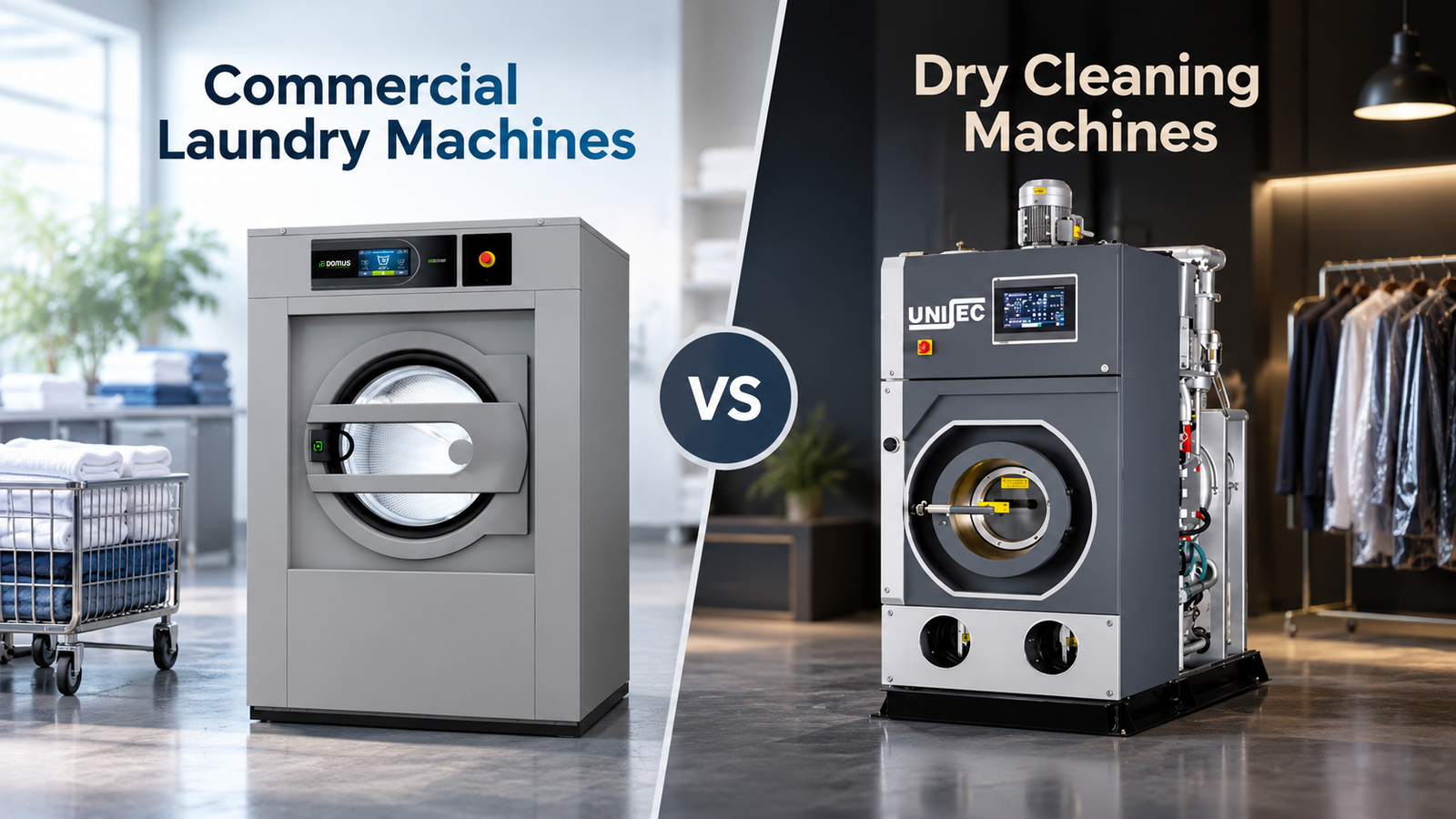
Commercial Laundry Machines vs Dry Cleaning Machines: What’s the Difference?
The main difference is the cleaning process.
Commercial Laundry Machines use water, detergents, and controlled wash programs to process suitable garments and textiles. A dry cleaning machine uses an approved solvent-based process instead of conventional water washing.
Commercial laundry is commonly suited to washable garments, towels, sheets, uniforms, and other textiles. Dry cleaning is used for garments that require a suitable professional solvent-based cleaning process. The right choice therefore starts with what your customers need cleaned.
What Are Commercial Laundry Machines and How Do They Work?
Commercial laundry equipment is designed for professional operations processing regular laundry volumes.
A typical setup may include a commercial washer extractor for washing and moisture extraction, a commercial tumble dryer for drying, and finishing equipment for ironing or pressing. These machines are selected according to workload, textile type, operating hours, and required turnaround time. Unlike household equipment, a commercial washing machine is intended to support a business workflow with repeated daily processing.
What Is a Professional Dry Cleaning Machine?
A professional dry cleaning machine processes suitable garments using an approved solvent system according to the machine manufacturer’s specifications.
Depending on the equipment, cleaning, solvent handling, filtration, drying, and other processes may be integrated within the system. An industrial dry cleaning machine can become an important part of a franchise targeting suits, jackets, coats, occasion wear, premium garments, and other items requiring specialist garment care.
What Types of Garments Can Commercial Laundry and Dry Cleaning Machines Handle?
Commercial laundry is commonly used for water-washable items such as everyday garments, towels, bedsheets, uniforms, restaurant linen, and other suitable textiles.
Dry cleaning can serve selected formalwear, structured garments, premium clothing, coats, and other garments where the care label and construction call for an appropriate professional process.
Garment care labels, fabric construction, trims, stains, colourfastness, and manufacturer instructions should always be considered before deciding the cleaning method.
What Commercial Laundry Equipment Does a New Franchise Need?
The exact laundry franchise equipment depends on the business model, but a typical setup may require:
- Commercial washer extractor
- Commercial tumble dryer
- Ironing or pressing equipment
- Spotting equipment
- Work tables and garment racks
- Chemical dosing or handling systems
- Packaging and order-management equipment
A franchise targeting B2B linen may require a different equipment mix from a neighbourhood retail laundry.
What Dry Cleaning Equipment Does a New Franchise Need?
A dry cleaning business setup usually requires more than the main machine.
Depending on the service offering, the operation may also need spotting equipment, steam finishing or pressing equipment, garment racks, work tables, packaging systems, an air compressor or steam source where required, and other supporting equipment. The entire workflow should be planned before calculating the final investment.
Commercial Washing Machine vs Dry Cleaning Machine: Which Should You Buy First?
Start with customer demand. If most expected orders are washable clothing, linen, towels, or uniforms, Commercial Laundry Machines may form the foundation of the business.
If the target market includes significant demand for professional care of suitable formal, premium, or specialist garments, investing in a dry cleaning machine may be justified. Do not buy equipment first and then search for demand.
How Much Does Commercial Laundry Equipment Cost?
The commercial laundry machine price in India depends mainly on capacity, machine type, brand, automation, heating configuration and technical features. As a general 2026 market reference, a commercial washer extractor can start around ₹1.8–₹2.8 lakh for a 10 KG machine, while a 20–30 KG washer extractor may cost approximately ₹3.5–₹8 lakh. Larger industrial machines can move well above ₹10 lakh, particularly for higher capacities and premium configurations.
Drying equipment also needs to be included in the budget. Depending on capacity and heating type, commercial tumble dryers can range from roughly ₹70,000 for smaller entry-level units to ₹8 lakh or more for larger commercial machines.
However, the machine purchase price is only one part of the actual investment. Installation, electrical work, plumbing, drainage, ventilation, gas or steam infrastructure where applicable, chemical dosing systems and supporting equipment can increase the overall commercial laundry equipment cost.
A more practical way to calculate your budget is:
Total Laundry Equipment Cost = Machines + Installation + Utilities + Site Preparation + Supporting Equipment
For example, a business purchasing a ₹5 lakh washer should not assume that ₹5 lakh represents the complete setup cost. Always calculate the full project requirement before finalizing your equipment investment.
How Much Does a Professional Dry Cleaning Machine Cost?
The dry cleaning machine price in India varies even more because the cost depends on capacity, solvent technology, tank configuration, filtration or distillation system, heating method, controls and overall machine configuration.
As an indicative market range, 8–10 KG professional dry cleaning machines may cost around ₹6–₹10 lakh, while 10–12 KG machines can fall around ₹8–₹15 lakh. For growing operations, 15–16 KG machines may range from approximately ₹12–₹20 lakh, while larger 18–20 KG systems can reach ₹18–₹25 lakh or more. High-capacity commercial configurations can exceed ₹20–₹35 lakh, depending on the technology and specifications selected.
Current marketplace listings also demonstrate why buyers should treat these figures as indicative: multi-solvent and hydrocarbon machines are listed across a very wide price spectrum depending on manufacturer, capacity and configuration.
Instead of choosing a professional dry cleaning machine solely because it has the lowest purchase price, compare:
Machine Price + Installation + Utilities + Solvent System + Supporting Equipment + Finishing Equipment + Operating Requirements
The right investment is not necessarily the cheapest machine. It is the equipment configuration that matches your expected garment volume, service mix, available infrastructure and future business growth.
Laundry vs Dry Cleaning: Which Requires a Higher Business Investment?
Neither model is automatically more expensive.
A large commercial laundry setup with multiple washers, dryers, and finishing machines may require significant investment. A professional dry cleaning operation can also involve substantial equipment and supporting infrastructure.
Compare:
Equipment + Installation + Utilities + Space + Supporting Systems + Initial Operating Requirements
Your required capacity and business model determine the actual laundry business investment or dry cleaning investment.
Which Business Has Higher Operating Costs: Laundry or Dry Cleaning?
Operating costs differ rather than following one universal pattern.
Commercial laundry may involve water, electricity or other heating energy, detergents, labour, drying, finishing, maintenance, and packaging.
Dry cleaning costs can include compatible solvent-related expenses, utilities, labour, maintenance, spotting, finishing, and other process requirements.
Calculate costs using your actual equipment and local utility prices.
Laundry vs Dry Cleaning: Which Business Has Better Earning Potential?
Revenue alone cannot determine which model is better.
Instead calculate:
Contribution = Revenue − Variable Processing Costs
Then consider fixed expenses such as rent, salaries, marketing, administration, and other overheads.
A high-volume laundry can still perform poorly if pricing is weak. A premium dry cleaning operation can also struggle if garment volume is insufficient.
The better model is the one supported by sustainable local demand and healthy unit economics.
Should a New Franchise Start with Laundry or Dry Cleaning?
For a new laundry franchise setup, study the local customer base before selecting equipment.
Ask:
What are customers already paying to clean?
If demand is mainly everyday laundry and washable textiles, commercial machines may deserve priority. If your location has strong demand for formalwear and specialist garment care, dry cleaning may become more important.
Your equipment strategy should follow your service strategy.
What Machines Do You Need for a Complete Laundry and Dry Cleaning Business?
A complete garment-care operation could include:
Washer Extractor → Tumble Dryer → Dry Cleaning Machine → Spotting → Finishing → Packaging
The exact combination depends on what services are provided.
Avoid buying every available machine from the beginning. Identify the equipment required to fulfil your initial service mix, then plan expansion around real demand.
Multi Solvent vs Hydrocarbon Dry Cleaning Machine: Which Should You Consider?
A multi-solvent dry cleaning machine may be designed for specified compatible solvent options, while a hydrocarbon dry cleaning machine is designed around an applicable hydrocarbon-based process.
Do not assume every solvent can be used in every machine.
Compare manufacturer-approved solvent compatibility, capacity, utilities, installation requirements, garment-processing needs, maintenance, and your intended business model before selecting equipment.
How Much Space and What Utilities Do Laundry and Dry Cleaning Machines Require?
Site planning should happen before equipment is ordered.
A laundry may require appropriate water supply, drainage, electrical capacity, ventilation, gas or steam where applicable, and space for washing, drying, finishing, sorting, and storage.
Dry cleaning equipment has its own model-specific installation and utility requirements. Always check the technical specifications of the selected machines.
How to Choose the Right Machine Capacity for Your Laundry Franchise
Start with expected daily workload:
Average Required Load Capacity = Expected Daily Volume ÷ Practical Loads per Day
For example, a projected 200 KG/day divided across 10 practical loads equals an average 20 KG per load.
This is only a planning calculation. Actual selection must account for textile segregation, machine cycles, peak periods, operating hours, dryer throughput, and model specifications.
Can You Start Small and Add More Commercial Laundry Machines Later?
Yes, staged expansion can be considered when the site and utilities are planned accordingly.
Starting with equipment matched to validated demand can reduce unnecessary initial investment. As order volume and contracts increase, additional laundry machines for business can be evaluated.
But avoid buying too small simply to reduce upfront cost. Equipment that becomes a bottleneck immediately can restrict growth.
What Should You Check Before Buying Laundry or Dry Cleaning Equipment?
Use this sequence:
Customer Demand → Service Mix → Daily Volume → Capacity → Space → Utilities → Investment → Operating Cost → Expansion
Also evaluate installation requirements, operator training, maintenance, spare parts, service support, and compatibility between different production stages.
Commercial Laundry or Dry Cleaning: Which Setup Is Right for Your Franchise?
Choose a commercial laundry setup when your core demand centres on water-washable garments and linen.
Consider professional dry cleaning when suitable specialist garment care represents a meaningful part of expected demand.
Consider both when your market supports a broader garment-care operation and the additional dry cleaning business investment can be commercially justified.
There is no universal winner—the right setup is the one aligned with your customers.
How Orgaearth Can Help You Choose the Right Laundry Franchise Equipment
Orgaearth can help entrepreneurs evaluate commercial laundry equipment and professional dry cleaning solutions according to expected volume, garment mix, available space, utilities, budget, and expansion plans. Rather than selecting individual machines in isolation, the complete workflow can be considered—from washing or dry cleaning through drying, spotting, finishing, and final delivery. This helps a new franchise build an equipment plan around actual business requirements.
Conclusion
Choosing between Commercial Laundry Machines and dry-cleaning equipment starts with understanding the business you want to build.
Commercial laundry can form the foundation for washable garments and linen, while professional dry cleaning can expand the service range into suitable specialist garment care.
Before investing, follow:
Demand → Services → Volume → Equipment → Capacity → Cost → Expansion
The goal is not to own more machines. It is to invest in the right equipment to serve profitable customer demand efficiently.
Contact Us
Orgaearth Laundry Solutions
Plot no 774 Udyog Vihar, Phase 5, Gurugram, Haryana, India- 122016
Email: marketing@orgaearth.com
Contact No.- +91 7042912777
Frequently Asked Questions
No. Commercial laundry machines generally use water-based washing processes, while dry cleaning machines use compatible solvent-based processes for suitable garments.
A setup may include washer extractors, tumble dryers, finishing equipment, spotting equipment, chemical systems, racks, work tables, and packaging equipment depending on the services offered.
There is no standard price. Capacity, machine type, configuration, installation, utilities, manufacturer, and supporting equipment all affect total cost.
A boutique or startup operation may consider approximately 10–12 kg capacity, while growing commercial businesses may require 15–20 kg or higher. Calculate capacity from realistic daily processing volume and batch requirements.
Start with the service for which you have stronger validated local demand. Customer mix, investment capacity, garment types, competition, and operating requirements should guide the decision.
Yes. A franchise can offer both when customer demand, available space, staff capabilities, infrastructure, and investment support a combined operation.