

10 Types of Laundry Chemicals and Their Uses for Starting a Commercial Laundry Business
Commercial laundry chemicals include detergents, wet-cleaning products, fabric conditioners, softeners, stain removers, bleaching agents and specialist textile-care chemicals. The right combination depends on the fabrics, stains and services a laundry business handles.
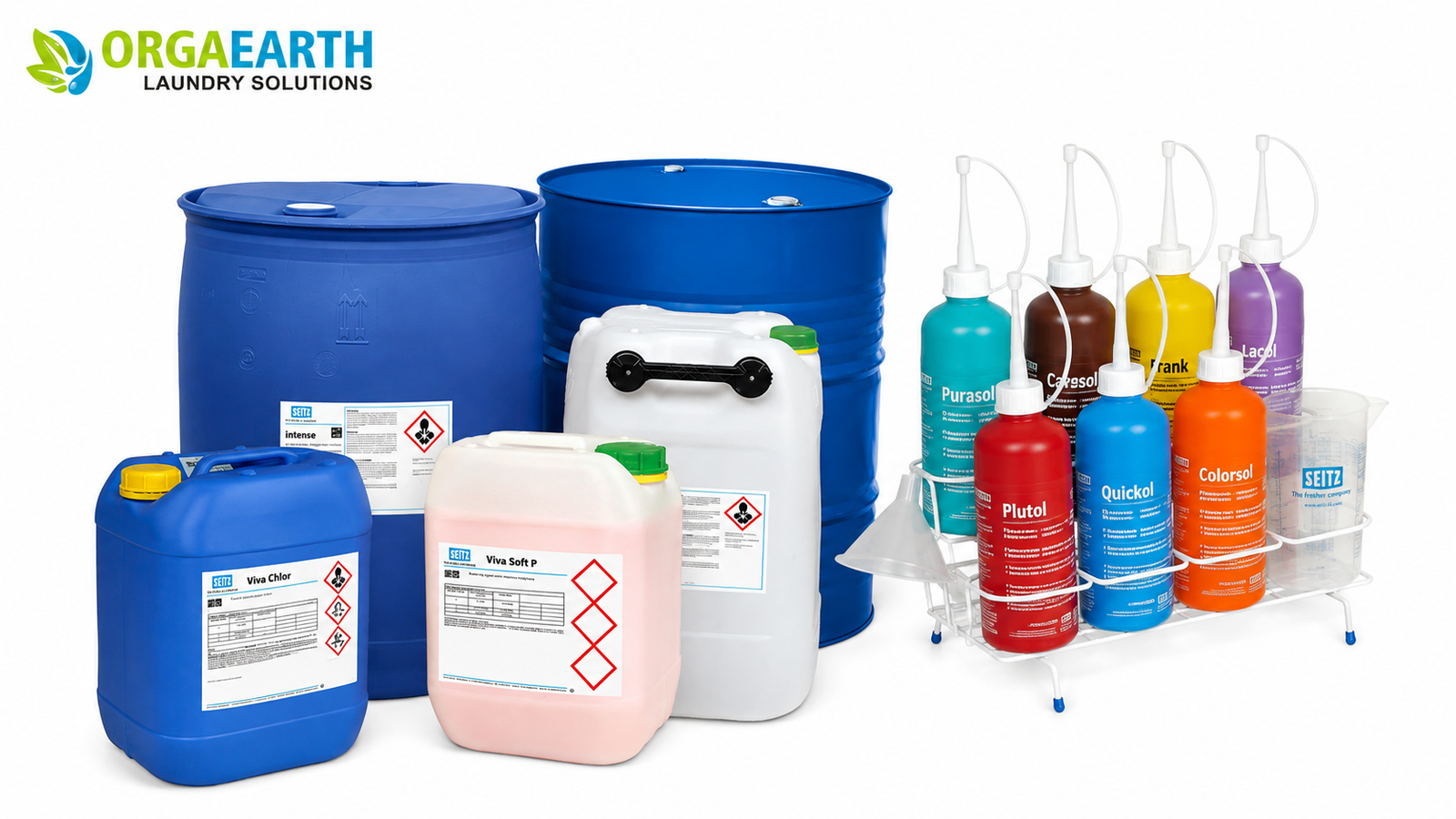
Starting a commercial laundry business involves much more than installing washing machines, dryers, and finishing equipment. The chemicals used throughout the cleaning and finishing process play an equally important role in wash quality, stain removal, fabric appearance, softness, and consistency.
Different textiles and stains require different treatment. A chemical suitable for everyday washable garments may not be appropriate for silk, wool, leather, suede, or heavily stained fabrics. This is why professional laundries use specialized commercial laundry chemicals instead of relying on one detergent for every application.
Below are 10 chemical categories, with examples from the Seitz Professional Textile Care range available through Orgaearth.
What Laundry Chemicals Does a New Commercial Laundry Business Need?
There is no universal chemical list that every laundry must purchase. The right selection depends on the services the business intends to offer.
A general commercial laundry may primarily need detergents, stain-treatment products, bleaching agents, and finishing chemicals. A premium garment-care operation may also require products for wool, silk, viscose, leather, suede, and specialty stain removal.
When selecting professional laundry chemicals, consider:
- Fabrics and garments you expect to process
- Types and severity of stains
- White versus coloured textiles
- Wet-cleaning requirements
- Finishing requirements
- Shoe, leather, or suede services
- Daily processing volume
1. Commercial Laundry Detergent for Regular Washing
A professional detergent is the foundation of routine washing.
Acura Wash is a regular detergent from the Seitz Professional Textile Care range. According to the provided product list, it features a fresh fragrance and active enzyme.
For a new laundry business, regular detergent will generally be one of the first chemical categories to consider because it supports the core washing service. The detergent should be matched with the textile, soil conditions, machine program, and other chemistry used in the process.
2. Wet Cleaning Detergent for Delicate Textiles
A laundry business that wants to expand beyond standard washable garments may need dedicated wet-cleaning chemistry.
Viva Silk is listed as a wet-cleaning detergent for cleaning carpets made from wool, silk, and viscose.
These materials require greater process control than everyday washable textiles. Using a specialized wet cleaning detergent gives the business a product designed for these particular applications rather than attempting to process every material with a general-purpose detergent. For businesses planning premium textile-care services, specialist wet-cleaning chemistry can therefore become an important part of the service portfolio.
3. Garment Finishing Chemicals and Conditioners
Cleaning is only one part of professional garment care. How the garment looks and feels after processing also affects the customer’s perception of quality.
Viva Finish is identified in the provided list as a conditioner suitable for garments that require shaping and finishing.
Finishing chemistry can support the final presentation stage, particularly where a business handles garments rather than only bulk linen. For a professional laundry or garment-care operation, this highlights an important principle: the chemical process does not necessarily end when the textile becomes clean. Finishing requirements should also be considered when designing the complete service.
4. Commercial Fabric Softener
Softness and fragrance can be important quality indicators, particularly for towels and selected garments.
Acura Soft is a liquid softener listed for towels and other garments, with fragrance as part of its application.
A laundry softener for commercial use can therefore form part of a professional finishing process when the required result includes softness and a pleasant textile feel. For businesses processing hospitality linen, towels, and customer garments, fabric-conditioning requirements should be considered while developing wash programs.
5. Grease and Heavy Stain Removal Chemicals
Some stains require more focused treatment than a standard wash cycle can provide.
Frankopal Maxx is listed for removing particularly tenacious grease stains, including applications involving cuffs, collars, sports items, and sneaker shoes. This type of laundry stain remover can be useful for businesses that regularly receive garments with concentrated greasy or difficult soils.
Pre-treatment and targeted stain removal can also help avoid repeatedly washing an entire garment simply because one small area remains stained. For a new business, specialist stain-removal capability can be particularly valuable when building a reputation for professional garment care.
6. Specialist Stain Removal Chemicals
Not every difficult stain is grease-based.
Blankotex is intended for tenacious stains, including coffee, tea, red wine, fruit juice, and other substances. These are common stains that professional laundries, hospitality laundries, and garment-care businesses may encounter.
Having appropriate specialist stain-treatment chemistry allows operators to identify the stain first and then select a suitable treatment instead of relying on additional detergent or aggressive general washing. This is also where staff training becomes important. A good commercial laundry chemical system depends on correct product selection and application not simply the number of chemicals available.
7. Rust and Metallic Stain Removal Chemicals
Rust and metallic oxide stains require a different approach from food, beverage, or grease stains.
Ferrol is described in the provided list as a post-spotting agent for stains caused by rust and other metallic oxides. This makes it a specialized product rather than an everyday washing chemical.
For a commercial laundry business, such products can broaden stain-removal capability and help operators respond to specific problems that general detergents are not designed to address. The broader lesson for new operators is straightforward: identify the stain category before choosing the treatment.
8. Leather and Suede Wet-Cleaning Chemicals
Leather and suede can create an opportunity for laundries that want to expand into specialized garment and shoe-care services.
The provided product range includes two complementary products:
WetX Wash is listed as a pre-brushing detergent, mixed with water, for leather and suede shoes and jackets.
WetX Finish is a finishing product intended to be added during the final rinse.
Together, they illustrate how professional processing can involve more than one chemical stage. For businesses considering shoe cleaning, jacket care, or premium garment services, dedicated laundry chemical solutions for leather and suede can help build a more specialized service offering.
9. Chlorine Bleach for White Fabrics
White fabrics can require additional treatment where stain removal and whiteness are important.
Prime Chlor is identified in the supplied list as a hypochlorite bleach specifically for white fabrics only.
Bleaching chemicals should never be treated as universal stain removers. Fabric colour and compatibility must be considered before use. For a commercial laundry, chlorine-based bleaching chemistry may have a defined role within suitable white-fabric processes, but operators need clear procedures so it is not mistakenly applied to incompatible garments.
Correct sorting therefore becomes as important as correct chemical selection.
10. Oxygen Bleach for White and Coloured Garments
The chemical list also includes Viva Geniox, described as a mild oxygen bleach that can be used for white and colored garments.
This gives a commercial laundry another bleaching category for applications different from a white-fabric-only hypochlorite product. The distinction between chlorine bleach and oxygen bleach is important for new laundry owners because bleaching chemistry should be selected according to the garment, colour, wash process, and product instructions.
Instead of asking, “Which bleach is strongest?” professional operators should ask, “Which product is appropriate for this particular textile and application?”
How to Choose the Right Laundry Chemicals for Your Business
A new business does not necessarily need every available chemical from day one.
Start with your service mix. If the business primarily processes routine washable garments, its initial chemical requirements will differ from an operation offering wet cleaning, sneaker care, leather processing, stain removal, and premium garment finishing.
Create a matrix of:
Service → Textile → Common Stain → Required Process → Suitable Chemical
This makes purchasing more systematic and reduces the temptation to use one product for applications it was not intended to handle. Your laundry chemicals supplier should also be able to provide product-specific technical guidance rather than simply supplying containers.
Common Chemical Selection Mistakes New Laundry Businesses Make
One of the biggest mistakes is assuming that stronger chemistry automatically means better cleaning.
Other common problems include using the same chemical process for every fabric, failing to identify stains before treatment, applying bleach without considering textile compatibility, overlooking specialist finishing requirements, and using chemical price as the only purchasing criterion.
A commercial laundry should instead build repeatable processes.
The correct chemical, correct textile classification, appropriate treatment, trained operator, and suitable equipment should work together.
How Orgaearth Can Help You
Orgaearth helps businesses develop professional laundry and textile-care solutions according to their service requirements. For businesses planning commercial laundry, wet-cleaning, garment care, shoe care, or specialist textile services, Orgaearth can help identify suitable professional chemicals from the Seitz textile-care range based on the intended application.
This can include regular washing products, wet-cleaning detergents, garment conditioners, softeners, specialist stain-removal products, leather and suede processing chemicals, and bleaching solutions.
Beyond chemicals, Orgaearth can support businesses with commercial laundry equipment, dry-cleaning and wet-cleaning solutions, finishing equipment, chemical dosing solutions, installation, training, and ongoing technical support. This integrated approach allows a new laundry to plan its machinery, chemistry, and processes around the services it intends to offer.
Contact Us
Orgaearth Laundry Solutions
Plot no. 774, Udyog Vihar, Phase 5, Gurugram, Haryana, India-122016
Email: marketing@orgaearth.com
Contact No.: +91 7042912777
Frequently Asked Questions
Commercial laundries use different chemicals depending on fabric type, soil level, stains, and the required finish. Common categories include commercial laundry detergent, wet-cleaning detergent, bleach, fabric softener, garment conditioners, and specialist stain removers for grease, rust, beverages, and other difficult stains.
A new commercial laundry typically needs a professional detergent as its foundation, along with suitable stain-removal and finishing products. Bleach, wet-cleaning chemicals, fabric softeners, and specialist treatments can then be selected according to the garments, linen, and services the business plans to process.
The main types include detergents for general washing, bleaches for stain removal and whitening, softeners for fabric feel, conditioners for finishing, wet-cleaning chemicals for sensitive textiles, and specialist spotting chemicals for stains such as grease, rust, coffee, tea, and wine.
Choose chemicals according to the fabrics you process, stain and soil types, water conditions, wash temperature, machine type, required finish, and daily laundry volume. A hotel laundry, garment-care business, shoe-cleaning operation, and general commercial laundry may require different chemical combinations.
There is no universal dosage for every commercial laundry chemical. The correct quantity depends on the specific product, load size, soil level, water quality, wash program, and manufacturer recommendations. Professional laundries should follow the product's technical instructions and use controlled dosing to maintain consistent wash quality while avoiding unnecessary chemical consumption.