

Commercial Laundry Machine Installation Requirements: Water, Drainage, Power & Space
Understanding commercial laundry machine installation requirements before placing an order can help you avoid delays and unexpected site modifications. Whether you’re planning a hotel laundry, laundromat, hospital laundry or commercial plant, this guide explains what to check before your equipment arrives.
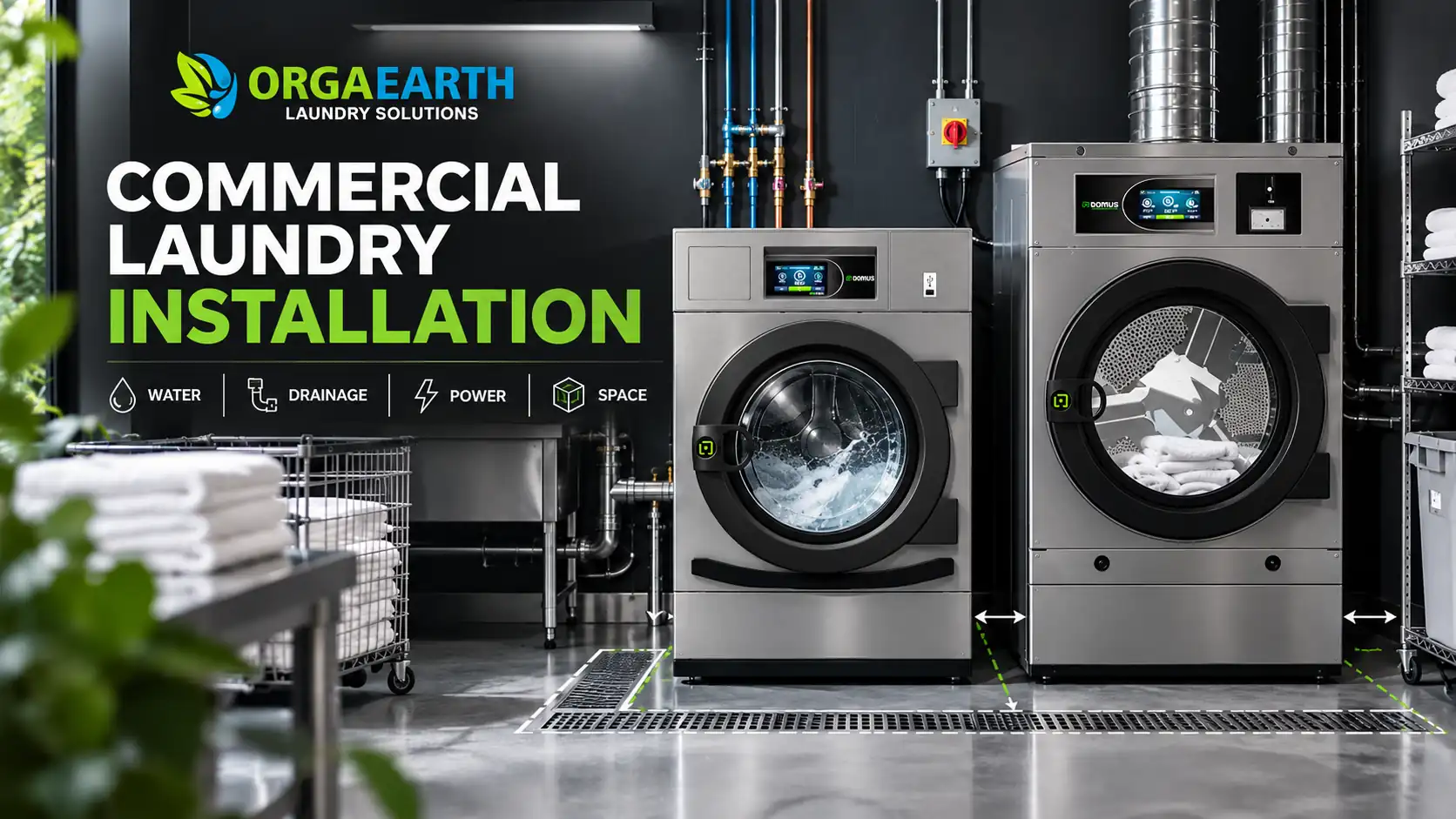
You’ve selected the washing machines and dryers for your laundry facility. But is your site actually ready to accommodate them?
Many businesses focus on machine capacity and price while overlooking the infrastructure needed for installation. A washer may fit inside the room but still require plumbing changes, additional electrical capacity or a stronger foundation.
Why Should You Inspect Your Laundry Site Before Buying Equipment?
Every professional laundry machine has specific utility and installation requirements. A smaller commercial washer may need relatively straightforward connections, while a larger washer extractor can require different drainage, mounting and electrical arrangements. Before finalising equipment, assess the building’s available water supply, power, drainage and floor conditions. Also consider access for unloading the machine and moving it to the installation area. A site inspection allows you to identify potential problems early and compare equipment based on what your premises can support.
Water Supply Requirements for Commercial Washing Machines
A reliable water supply is essential for consistent washing operations.
Commercial washers require water at the pressure and flow rate specified by the manufacturer. If supply is inadequate, filling times may increase and washing schedules may be affected.
Check these factors:
- Water pressure: Confirm the operating range required by the selected machine.
- Flow rate: Ensure pipes can deliver enough water during filling.
- Water connections: Check whether separate hot and cold inlets are needed.
- Storage: Consider adequate water reserves where supply is irregular.
- Water quality: Assess hardness and other relevant conditions.
If several machines will operate together, evaluate their combined demand rather than checking each one separately.
When comparing commercial washer extractors, review the technical specifications for the exact model before designing plumbing connections.
How Much Water Will Your Laundry Plant Need?
Daily water demand depends on machine capacity, programme selection, load composition and operating hours.
A simple planning formula is:
Daily washing water demand = Water consumed per cycle × Number of cycles
For example, if a washer consumes 150 litres per cycle and completes eight cycles:
150 × 8 = 1,200 litres per day
This is only an illustrative calculation, not a specification for a particular machine.
Actual consumption may vary significantly between models and programmes.
If your plant uses multiple washers, calculate the expected requirements for each machine and add water required for other activities.
Commercial Laundry Machine Drainage Requirements
A washer extractor can discharge water rapidly during certain stages of operation.
If the drainage system cannot accommodate this flow, wastewater may back up and interrupt operations.
Before installation, confirm the drain outlet size, position, discharge requirements and pipe routing recommended by the manufacturer.
The system should also provide suitable maintenance access.
Facilities using several washers must consider simultaneous discharge. A drainage line sized for one machine may not be suitable when multiple units drain together.
Arrange for a qualified plumbing professional to assess the wastewater connection and applicable local disposal requirements.
Electrical Requirements: Single-Phase vs Three-Phase Power
Power requirements vary according to machine size, design and heating arrangement.
Some smaller commercial washers can use an appropriate single-phase connection. Other machines, especially larger or electrically heated models, may require three-phase electricity.
Check the equipment’s voltage, frequency, current and total electrical load before installation.
A qualified electrician should verify cable sizing, earthing, circuit protection and isolation arrangements.
If you plan to install several machines, assess the combined electrical demand and the site’s available sanctioned load.
Do not assume that two machines with similar kilogram capacities require the same electrical supply.
How Much Space Does Commercial Laundry Equipment Need?
The advertised machine dimensions do not represent the complete installation space.
You also need adequate clearance for loading, maintenance and daily movement.
Space consideration | Why it matters |
Machine footprint | Determines where equipment can be positioned |
Front clearance | Allows loading and unloading |
Side and rear access | Supports maintenance and utility connections |
Door opening | Prevents obstruction during operation |
Trolley routes | Supports movement of laundry |
Sorting and storage | Keeps processing areas organised |
Delivery access | Allows machinery to reach the installation point |
Check doorway widths, corridors, lifts and ceiling height before delivery.
Businesses evaluating larger DOMUS industrial laundry machines should also review the specific equipment dimensions and service clearances.
Do Washer Extractors Need Special Foundations?
Some commercial washing machines require floor anchoring, while others use suspended designs with different mounting arrangements.
The correct installation depends on the model, machine weight, extraction forces and structural conditions.
For example, rigid-mounted washer extractors may require secure anchoring to an appropriate foundation.
Suspended high-spin machines can reduce the forces transferred to the floor, but still require a suitable supporting structure.
Upper-floor installations need particular attention because the building must safely accommodate both the equipment weight and applicable dynamic loads.
Always follow the manufacturer’s foundation and mounting instructions. Consult a structural professional where necessary.
Commercial Tumble Dryer Ventilation and Exhaust Requirements
Dryers have installation needs beyond electrical or heating connections.
Many conventional commercial dryers release moist air through an exhaust system. Incorrect ducting or insufficient replacement air can affect drying performance.
Before installation, check:
- Required exhaust connection and duct arrangement
- Permitted duct length and bends
- Replacement or make-up air requirements
- Access for lint removal and maintenance
- Gas or steam connections, where applicable
- Heat and humidity management
Different dryer technologies may have different requirements, so a single exhaust arrangement will not suit every model.
Review the selected commercial tumble dryer range and confirm the installation specifications for the particular machine.
How to Plan an Efficient Laundry Room Layout
A practical layout should support the movement of laundry from receiving to dispatch.
A typical production sequence is:
Receiving → Sorting → Washing → Drying → Finishing → Quality Check → Dispatch
Avoid placing machinery in ways that require unnecessary trolley movement or repeated handling.
Keep loading areas accessible and allow suitable separation between soiled and clean textiles, particularly in healthcare applications.
Provide dedicated space for chemicals, storage, and maintenance activities where required.
Planning these areas before installation makes future expansion and daily operations easier to manage.
Commercial Laundry Installation Checklist Before Delivery
Use this checklist when reviewing your facility with the equipment supplier and technical contractors.
Check | What to verify |
Machine specifications | Exact model, dimensions and weight |
Water supply | Pressure, flow, temperature and connections |
Drainage | Outlet size, discharge capacity and pipe routing |
Electrical supply | Voltage, phase, connected load and safety protection |
Floor | Structural suitability, levelling and anchoring |
Dryer ventilation | Exhaust arrangement and make-up air |
Installation space | Loading and servicing clearances |
Delivery route | Building access and equipment movement |
Commissioning | Testing, inspection and operator instructions |
Keep the manufacturer’s installation manual available during site preparation.
Final commissioning should be completed according to the equipment supplier’s procedures before regular production begins.
Common Installation Mistakes to Avoid
One frequent mistake is ordering equipment based only on capacity without checking the available utilities.
Another is measuring the machine footprint while overlooking service clearances or the delivery route.
Undersized drainage, insufficient electrical load and unsuitable dryer exhaust arrangements can also create problems.
These issues are often more expensive to correct after machinery arrives.
Before confirming a purchase, share your site details and expected laundry volume with the supplier so the equipment can be assessed against the premises.
How Orgaearth Can Help with Commercial Laundry Installation
Orgaearth Laundry Solutions supplies commercial and industrial laundry equipment for hotels, hospitals, laundromats and institutional facilities across India. Its range includes DOMUS and LG washer extractors, commercial tumble dryers and professional finishing equipment. Orgaearth also provides support with equipment selection, site assessment, installation planning and commissioning.
If you’re setting up a new laundry or upgrading an existing facility, explore Orgaearth’s commercial laundry equipment range and discuss your available space, utilities and processing requirements before purchasing.
Conclusion
Choosing suitable machinery is only one part of preparing a professional laundry facility. Water supply, drainage, electrical capacity, foundations, ventilation and working space must all support the selected equipment. The exact requirements vary by model, so generic installation estimates should never replace manufacturer specifications. A proper site assessment before ordering can help reduce avoidable delays, improve installation readiness and support reliable daily operations.
Contact Us
Orgaearth Laundry Solutions
Plot no. 774, Udyog Vihar, Phase 5, Gurugram, Haryana, India 122016
Email: marketing@orgaearth.com
Contact No.: +91 7042912777
Frequently Asked Questions
A suitable water supply, drainage connection, electrical service, installation space and compatible floor or foundation are generally required. Exact specifications depend on the machine model.
Not all models do. Smaller machines may use single-phase connections, while larger or electrically heated equipment may require three-phase supply.
Drain size depends on the model's outlet and discharge requirements. Always use the manufacturer's installation specifications and assess the capacity of the receiving drainage system.
It may be possible if the structure can safely support the equipment and its operating forces. A qualified structural assessment may be necessary.
Many conventional commercial dryers do. Ventilation and exhaust requirements depend on the dryer technology and selected model.
Follow the manufacturer's minimum clearances and allow additional working space for loading, maintenance, trolley movement and safe access.