

Hard-Mount vs Soft-Mount Washer Extractor: What’s the Difference and Which One Should You Choose?
The hard-mount vs soft-mount washer extractor decision should therefore be made according to your laundry site and operating requirements. Understanding the differences can help hotels, hospitals, laundromats, and commercial laundries choose equipment that fits both their workload and installation conditions.
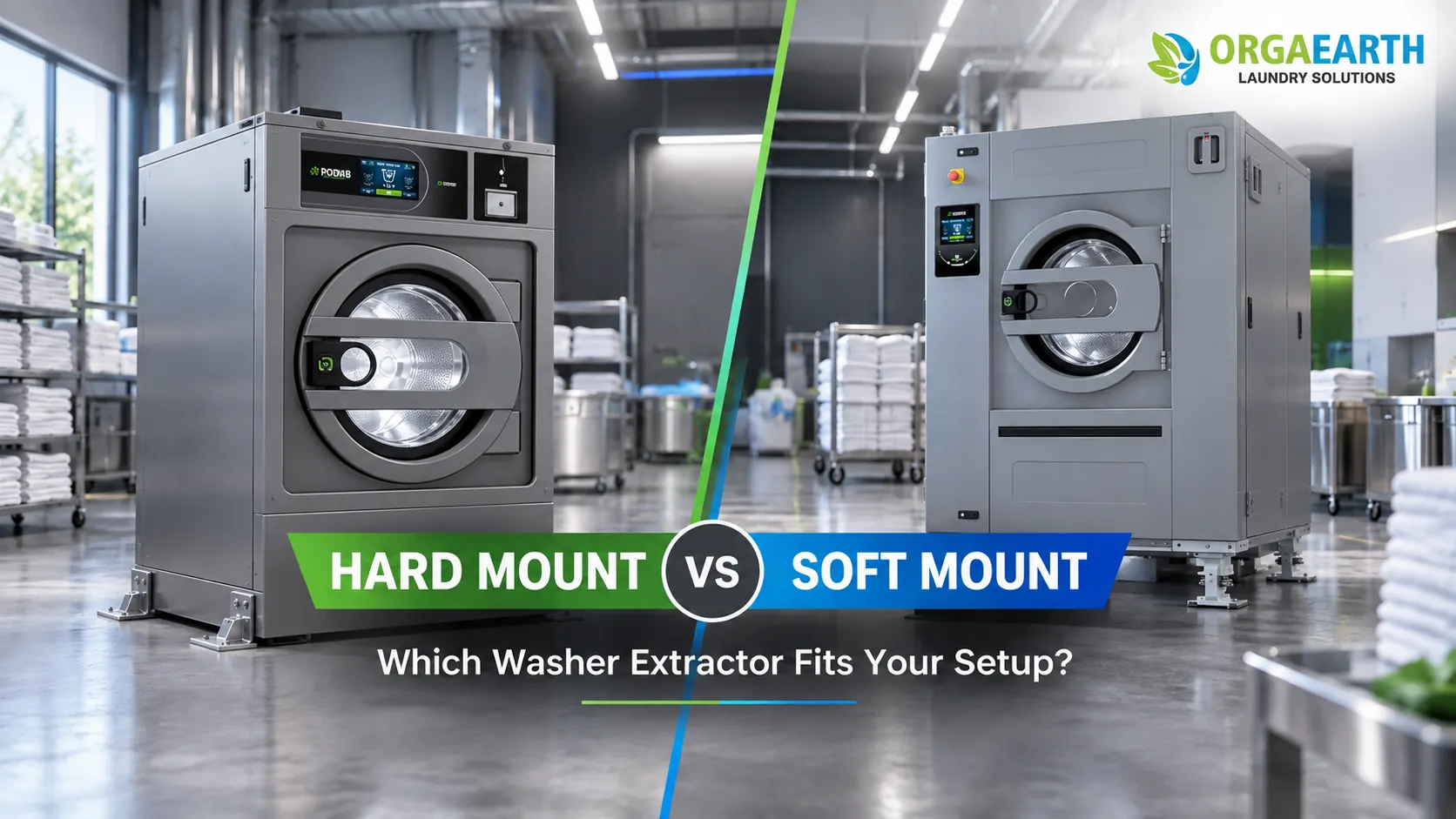
What Is the Difference Between Hard-Mount and Soft-Mount Washer Extractors?
The main difference is how the machines manage forces and vibration during extraction.
A hard mount washer extractor has a rigid design and is typically anchored securely to a suitable foundation. The supporting structure plays an important role in managing the forces created while the drum operates at extraction speed.
A soft mount washer extractor, also called a suspended washer extractor, uses an internal suspension system to isolate more of these forces within the machine. This can reduce the dependence on the type of substantial foundation and anchoring associated with hard-mount installations.
In simple terms:
Hard Mount → Rigid Installation → Anchoring & Foundation Important
Soft Mount → Suspended Design → Greater Installation Flexibility
This difference affects much more than installation. It can influence where the washer can be installed, how relocation is handled and which machine configuration makes sense for the site.
What Are the Features and Characteristics of Hard-Mount and Soft-Mount Washer Extractors?
Both types are designed for professional laundry processing, but their construction creates different characteristics.
Hard Mount Washer Extractor
A hard-mount washing machine is rigidly installed and generally requires proper anchoring according to the manufacturer’s instructions.
Typical characteristics include:
- Rigid machine design
- Anchored installation
- Specific foundation or floor requirements
- Model-dependent extraction performance
- Suitable for permanent laundry installations
- More work involved if the machine needs relocation
The exact foundation, anchoring and installation requirements depend on the specific machine. They should always be checked before preparing the laundry site.
Soft Mount Washer Extractor
A soft-mount machine uses a suspension system designed to isolate more vibration and movement during operation.
Typical characteristics include:
- Suspended machine design
- Internal vibration isolation
- Greater installation flexibility
- Less dependence on substantial anchoring in many designs
- Common availability in high-spin configurations
- Generally easier relocation than an anchored machine
This can be useful where extensive foundation work is difficult or where the laundry layout may change later.
However, “soft mount” does not mean a machine can be installed anywhere. The floor, structure, utilities and installation conditions must still meet the manufacturer’s requirements.
Which Technical Specifications Should You Compare Before Buying a Washer Extractor?
Mounting type is only one part of the buying decision. When comparing a commercial washer extractor, check the complete technical specification.
Important specifications include:
Rated Capacity: Shows the machine’s nominal load capacity in KG. Choose it according to practical daily laundry volume rather than simply buying the largest available machine.
Drum Volume: Helps you understand the physical space available for textiles inside the drum.
Extraction RPM: Indicates how quickly the drum rotates during extraction, but RPM should not be considered alone.
G-Factor: Indicates the centrifugal force created during extraction. Drum diameter and rotational speed both affect extraction force, so two machines with similar RPM may not provide identical extraction performance.
Residual Moisture: The amount of moisture left in textiles after extraction can affect the work required during drying. Actual results depend on the textile, program and machine.
Controls and Programs: Programmable cycles can help laundries process different textile types using suitable wash settings.
Also compare water requirements, electrical load, heating configuration, drainage, machine dimensions, machine weight, chemical dosing compatibility and required service clearance.
For a high spin washer extractor, extraction performance is particularly important because effective moisture removal can potentially reduce the requirement at the drying stage.
The better approach is:
Capacity + Drum + Extraction + G-Factor + Utilities + Controls + Installation
rather than comparing machines only by KG or RPM.
How Do Hard-Mount and Soft-Mount Washer Extractors Differ in Installation and Foundation Requirements?
Installation is one of the biggest practical differences between the two designs.
A hard-mount commercial washer generally relies more heavily on a suitable supporting structure to manage forces generated during operation. Depending on the model, installation may involve foundation preparation, positioning, levelling, drilling, anchoring and grouting where specified.
A simplified process can look like:
Site Check → Foundation Preparation → Position → Level → Anchor → Utility Connection
This can make installation more involved. Relocation can also require additional work because the machine is secured to the supporting structure.
A soft-mount machine uses its suspension system to isolate more vibration. In many designs, this can reduce the extensive anchoring and foundation work associated with hard-mount machines.
A simplified process may look like:
Site Check → Position → Level → Utility Connection → Model-Specific Installation Checks
This can make a soft mount washer extractor installation more flexible in suitable locations.
It is important, however, not to apply one manufacturer’s specifications to every machine. Requirements such as concrete thickness, anchoring method and allowable floor type vary by model.
Before purchasing either type, check the manufacturer’s installation manual and confirm that the building structure, floor and utilities can support the selected equipment.
Hard Mount vs Soft Mount Washer Extractor: Which One Should Your Laundry Choose?
There is no single answer for every commercial laundry.
A hard-mount washer may make sense where a suitable permanent foundation is available and the machine will remain in a fixed position. A soft-mount machine may be useful when installation flexibility, vibration isolation or easier future relocation is important.
Use the following factors to compare them:
Factor | Hard Mount | Soft Mount |
Design | Rigid | Suspended |
Vibration Management | Relies more on supporting structure | Internal suspension isolates more vibration |
Anchoring | Typically required | Depends on model; often less extensive |
Foundation | More important | Generally more flexible |
Installation | Can require more site work | Often simpler |
Relocation | More involved | Generally easier |
Extraction Performance | Model-specific | Model-specific |
Capacity | Model-specific | Model-specific |
Before deciding, follow this sequence:
Daily Laundry Volume → Textile Mix → Required Extraction → Site/Floor → Utilities → Installation Requirements → Machine Specification → Budget
For example, choosing a soft mount solely because installation appears easier would ignore capacity, controls and processing requirements. Similarly, choosing a hard mount only because the site already has a concrete floor does not confirm that the floor meets the machine’s specififc structural requirements.
The right washer extractor for a laundry business is the one that fits both the processing requirement and the installation site.
How Orgaearth Can Help
Orgaearth helps commercial laundry businesses evaluate washer extractors according to capacity, extraction requirements, available space, utilities and site conditions.
With commercial and industrial washer extractor options across different capacities and configurations, Orgaearth can help you compare equipment based on your actual laundry requirement rather than one specification alone.
Before selecting a machine, the complete setup—including washing capacity, drying capacity, installation conditions and expected daily volume—should be considered together.
Conclusion
The difference between hard-mount and soft-mount washer extractors goes beyond how the machine is fixed to the floor. Their design affects vibration management, foundation requirements, installation flexibility and relocation.
At the same time, mounting type should never be the only buying factor. Capacity, drum volume, extraction performance, G-factor, controls, utilities and overall workflow also matter.
The best approach is simple:
Understand Your Laundry Requirement → Check Your Site → Compare Technical Specifications → Choose the Right Washer Extractor.
Contact Us
Orgaearth Laundry Solutions
Plot no. 774, Udyog Vihar, Phase 5, Gurugram, Haryana, India 122016
Email: marketing@orgaearth.com
Contact No.: +91 7042912777
Frequently Asked Questions
A hard mount washer extractor has a rigid design and is typically anchored to a suitable foundation or supporting structure according to the manufacturer's installation requirements.
A soft mount washer extractor uses an internal suspension system to isolate more of the forces and vibration created during operation, providing greater installation flexibility in many applications.
Hard-mount machines generally have specific foundation and anchoring requirements. The required foundation construction and thickness depend on the exact model and manufacturer specifications.
Some soft-mount designs can be installed without the extensive anchoring associated with hard-mount machines. Always follow the installation instructions for the specific model.
G-force describes the centrifugal force produced during extraction. It is influenced by drum size and rotational speed and helps indicate extraction performance.
Neither is universally better. Compare your floor conditions, installation location, laundry volume, extraction requirements, utilities, relocation needs and the technical specifications of the machines being considered.