

Washer Extractor Price in India: 10 KG–120 KG Cost & Which Capacity Fits Your Laundry?
This guide explains the washer extractor price in India, capacities from 10 KG to 120 KG, and the main factors to check before choosing a machine for your laundry business.
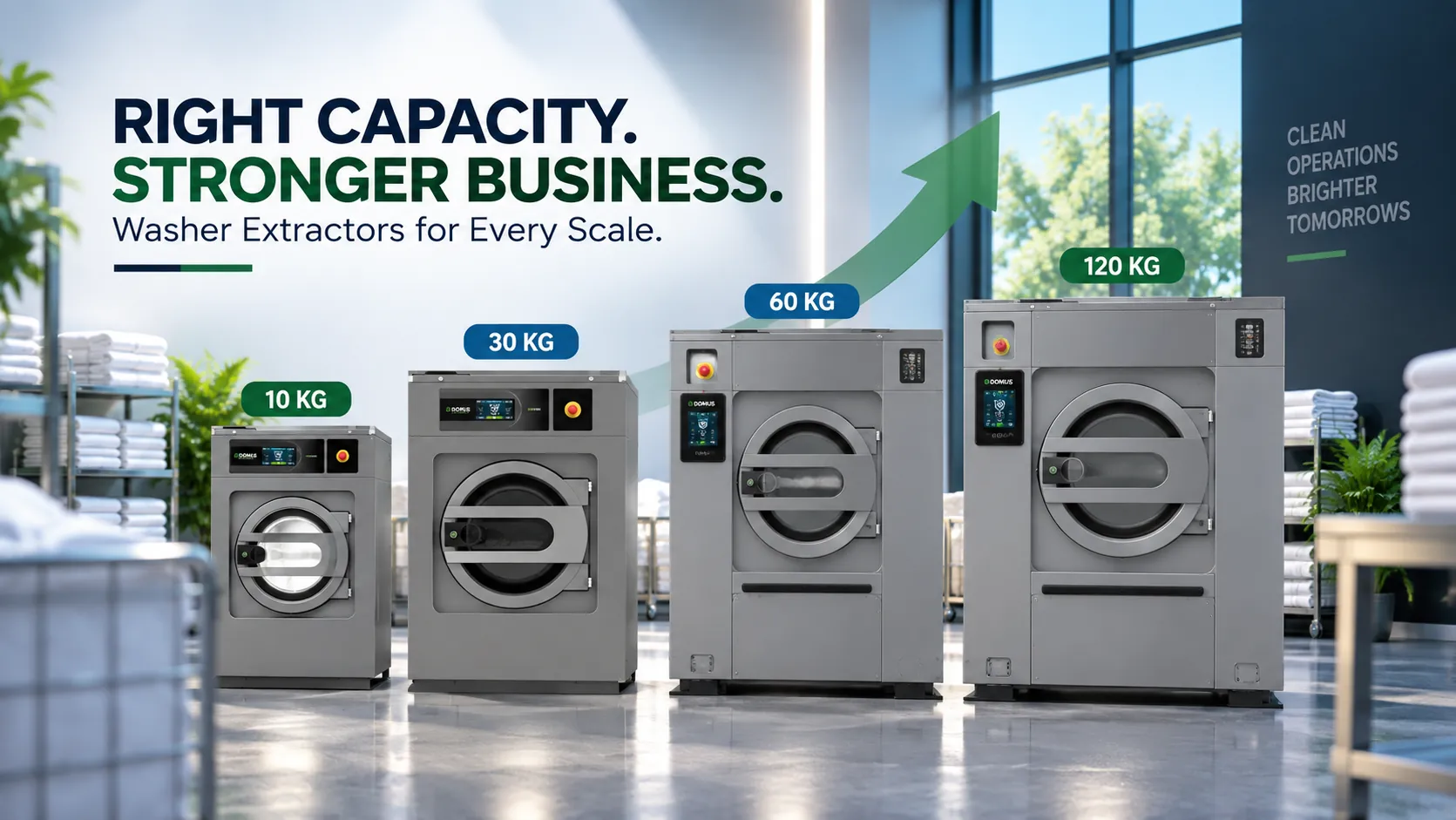
If you are planning a commercial laundry, one of the first questions is, ‘How much does a washer extractor cost?‘ The answer depends on more than capacity. Machine type, extraction speed, controls, installation, and utilities can all affect the final investment.
How Much Does a Washer Extractor Cost in India?
There is no single price for every washer extractor machine. A small-capacity machine and a 120 KG industrial machine are built for very different workloads.
The price can depend on:
- Machine capacity
- High-spin or low-spin configuration
- Hard-mount or soft-mount design
- Controls and wash programs
- Heating options
- Machine construction
- Installation requirements
- Brand and specifications
For this reason, comparing two machines only by price can be misleading.
For example, two 30 KG machines may have the same capacity but different extraction performance, controls or installation requirements.
When comparing industrial washer extractor prices, look at what you are getting for the investment—not just the KG capacity.
How Does Washer Extractor Price Change from 10 KG to 120 KG?
As capacity increases, the machine is designed to handle larger loads. But a bigger machine can also require different space, utilities and installation arrangements.
Here is a simple way to understand the capacity range:
Capacity | Suitable For | What to Check |
10–15 KG | Smaller commercial loads | Daily loads, programs, utilities |
20–30 KG | Growing laundries | Daily KG, extraction, workload |
40–60 KG | Higher-volume laundries | Throughput, drying capacity |
80–100 KG | Large laundry operations | Space, utilities, infrastructure |
Up to 120 KG | Industrial processing | Installation and total workflow |
Someone searching for a 10 KG washer extractor price will usually have very different requirements from someone looking for a 60 KG washer extractor price or 120 KG washer extractor price.
The important point is simple:
Do not buy a bigger machine just because you expect the business to grow.
A machine should match the loads you actually expect to process. If a large machine regularly runs with small loads, you may not use its capacity effectively.
At the same time, choosing a machine that is too small can increase the number of cycles required each day.
The right balance depends on your actual laundry volume.
What Washer Extractor Capacity Do You Need for Your Laundry Business?
Start with your daily laundry volume before choosing a washer extractor capacity.
A simple calculation is:
Required Loads Per Day = Expected Daily Laundry KG ÷ Practical Average Load
For example, suppose your laundry processes 300 KG per day and your practical average load is 25 KG:
300 ÷ 25 = 12 loads per day
This is only an example, not a recommended machine capacity.
You then need to ask whether those 12 loads can be completed comfortably within your operating hours.
Use this process:
Daily KG → Textile Type → Practical Load → Loads Per Day → Operating Hours → Required Capacity
Textile type is also important.
A hotel laundry processing bedsheets and towels may have different load requirements from a laundromat, hospital laundry or commercial laundry serving multiple businesses.
You may need to separate textiles instead of putting everything into one large load.
Also look beyond washing.
Your complete process could be:
Washing → Extraction → Drying → Finishing → Packing
If the washer processes 500 KG per day but your dryers can handle only 300 KG in the same operating period, drying becomes the bottleneck.
Your washing capacity should therefore work with the rest of your commercial laundry equipment.
What Affects Washer Extractor Price Besides Capacity?
Capacity is important, but it is not the only reason two machines can have different prices.
High Spin vs Low Spin
A high spin washer extractor can remove more moisture from textiles during extraction than a lower-spin configuration, depending on the machine and program.
In simple terms:
Higher Extraction → Less Moisture Left → Potentially Less Drying Required
This can be important for a busy laundry because drying is part of the total processing time.
However, actual results depend on the textile, wash program and machine specifications.
Hard Mount vs Soft Mount
You may also come across hard mount washer extractor and soft mount washer extractor machine options.
Hard-mount machines typically require more substantial anchoring and suitable foundation conditions.
Soft-mount machines use a suspension system that isolates more of the forces created during extraction.
Before choosing, compare:
- Floor and site conditions
- Installation requirements
- Extraction requirements
- Available space
- Machine specifications
- Expected workload
Neither type is automatically right for every laundry.
Controls and Machine Features
Controls, programmable wash cycles, construction, heating options and other specifications can also affect commercial washer extractor price.
Instead of comparing:
30 KG vs 30 KG
compare:
Capacity + Extraction + Controls + Construction + Installation + Application
This gives you a much clearer understanding of what you are paying for.
What Should You Calculate Before Buying a Commercial Washer Extractor?
Before buying, look at your complete laundry setup.
Calculate:
- Expected daily laundry KG
- Practical load size
- Number of loads per day
- Operating hours
- Textile types
- Required turnaround time
- Available drying capacity
- Water and drainage requirements
- Electrical and other utility requirements
- Available space
- Installation requirements
- Expected future volume
Most importantly, do not consider only the machine purchase price.
Use:
Total Washer Extractor Investment = Machine + Installation + Utilities + Site Preparation + Supporting Equipment
For example, a larger industrial washer extractor may require changes to your site or utilities. These requirements should be understood before the machine is purchased.
Also consider realistic future growth.
A useful approach is:
Current Laundry Volume + Realistic Growth = Planned Processing Requirement
This gives you some room to grow without automatically investing in significantly more capacity than you currently need.
How Orgaearth Can Help
Orgaearth helps commercial laundry businesses select washer extractors according to daily laundry volume, practical load requirements, textile type, available space, utilities and future processing needs.
Whether you need equipment for a smaller commercial laundry or a higher-volume industrial operation, the focus should be on choosing the right capacity and configuration for your actual workflow.
The objective is simple: buy the machine your laundry needs not simply the biggest machine your budget allows.
Conclusion
Choosing between a 10 KG and 120 KG washer extractor is not simply a price decision. Consider daily laundry volume, practical loads, extraction performance, installation, utilities and the capacity of your complete laundry workflow.
Choose equipment based on what your laundry needs today while keeping sensible room for future growth.
Contact Us
Orgaearth Laundry Solutions
Plot no. 774, Udyog Vihar, Phase 5, Gurugram, Haryana, India 122016
Email: marketing@orgaearth.com
Contact No.: +91 7042912777
Frequently Asked Questions
The price depends on capacity, machine configuration, extraction performance, controls, construction and installation requirements. Request a quotation based on the exact capacity and specifications required for your laundry.
Calculate your daily laundry KG, practical load size, number of loads and operating hours. Choose a capacity that can handle this workload without being regularly overloaded or underused.
High-spin extraction can remove more residual moisture and potentially reduce drying requirements. The right choice depends on your textiles, workload and machine specifications.
Hard-mount machines generally require more substantial anchoring, while soft-mount machines use suspension systems to isolate more extraction forces. Site conditions and machine requirements should guide the decision.
Plan for realistic growth, but avoid buying significantly more capacity than you expect to use. Balance current workload with reasonably expected future volume.